

.png)
Why Does My Skin Feel Rough Despite Exfoliating in Scottsdale?
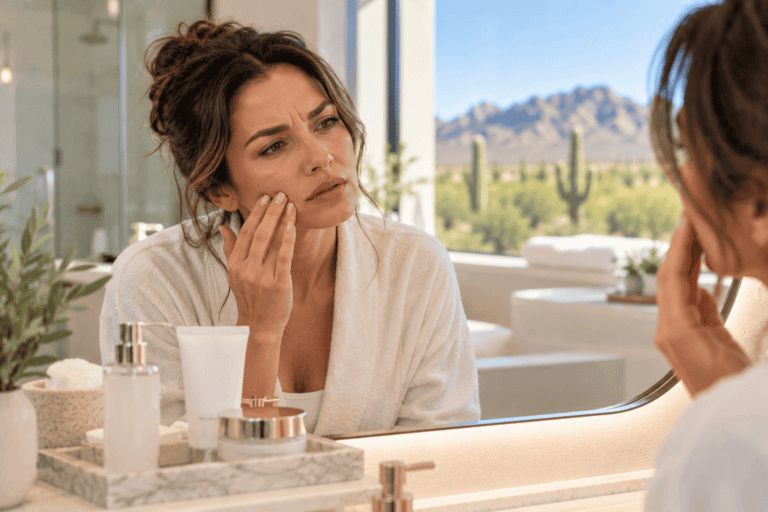
You're washing your face, using a scrub or an exfoliating acid a few times a week, and applying serums that promise smooth, radiant skin. But when you run your fingers across your cheeks, it still feels bumpy. Makeup sits unevenly instead of blending in. Your skin looks dull in photos no matter how much you moisturize. If this sounds familiar, the issue might not be your routine at all. It might be what your routine can't reach.
Standard exfoliation, whether that's a scrub, a cleanser, or a chemical exfoliant, only goes so far. It can't remove the layer of dead skin cells and fine vellus hair, often called peach fuzz, that builds up on the surface and blocks light, product, and makeup from doing what they're supposed to. That's the specific gap dermaplaning is designed to close, and it's worth understanding before you buy another product hoping for a different result.
Why Doesn't Regular Exfoliation Fully Smooth My Skin?
Regular exfoliation, whether physical or chemical, removes some dead skin cells but doesn't remove the fine vellus hair that traps oil, dirt, and dead skin against the surface, which is often what's actually causing the rough, dull texture you're noticing. Scrubs and acids work on the skin's surface chemistry, not on that physical barrier.
This is why people can be diligent about their skincare routine and still feel like their skin isn't as smooth as it should be. The vellus hair itself isn't the problem, but the buildup that collects around and beneath it is. Without physically removing that layer, even a strong exfoliating routine is working with one hand tied behind its back.
What Exactly Does Dermaplaning Do?
Dermaplaning uses a sterile surgical blade to gently scrape away the top layer of dead skin cells and fine facial hair in a single pass, revealing smoother, brighter skin immediately and allowing skincare products to absorb more effectively afterward. It's a manual exfoliation method, not a chemical one, which is part of why it works differently than anything in your at-home routine.
The immediate result is skin that looks noticeably smoother and more even in texture, often described as looking airbrushed. Because the treatment also removes the vellus hair layer, makeup tends to glide on more smoothly afterward instead of catching on texture or peach fuzz. Our dermaplaning treatments at Source of Health are performed by trained estheticians using medical-grade technique, which matters for both safety and results.
Is Dermaplaning the Same as Shaving Your Face?
Not quite, even though the tool involved is similar. Dermaplaning is performed by a trained professional using a specific blade angle and technique designed to exfoliate the skin's surface as well as remove hair, and it's typically done as part of a broader skincare treatment rather than a quick at-home routine.
There's also a persistent myth that removing facial hair this way makes it grow back thicker or darker. That's not the case. Vellus hair, the fine hair dermaplaning removes, grows back at the same fineness and rate it always did. What people notice afterward is smoother skin, not different hair growth.
Who Benefits Most From Dermaplaning?
People with dry or dull skin, visible texture, or fine facial hair that affects how makeup applies tend to see the most noticeable results, and it's a good option for anyone who can't tolerate more aggressive chemical exfoliation. It's also popular before events or photos, since results are immediate with no downtime.
Dermaplaning is generally not recommended for active acne breakouts, since the blade can spread bacteria across inflamed skin, but for most other skin types it's considered one of the gentler professional exfoliation options available. If you're unsure whether it's the right fit, that's exactly what a consultation is for.
Can Dermaplaning Be Combined With Other Treatments?
Yes, and it's often more effective when it is. Because dermaplaning removes the surface barrier of dead skin and hair, treatments performed afterward, like a chemical peel or a hydrating facial, can penetrate more effectively, which often means better results from the same session.
This is a common approach at Source of Health, where dermaplaning is frequently paired with a chemical peel or HydraFacial for patients dealing with both texture and deeper concerns like tone or fine lines. It's also a helpful step before microneedling, since a clear surface allows the treatment to work more evenly.
How Often Should You Get Dermaplaning?
Most people benefit from dermaplaning every three to four weeks, which lines up naturally with the skin's regeneration cycle. Some people schedule it monthly as part of an ongoing skincare maintenance routine, especially before events or during Scottsdale's drier months when texture tends to be more noticeable.
Because the treatment has no downtime, it fits easily into a regular routine without disrupting your schedule. Many patients pair it with their existing facials or skincare maintenance visits rather than treating it as a separate appointment.
Does Dermaplaning Work for Every Skin Type?
Dermaplaning is generally well tolerated across most skin types, since it doesn't rely on chemicals or heat that can trigger reactions in more sensitive or reactive skin. It's often recommended specifically for people who've struggled with irritation from chemical exfoliants, since the mechanical approach avoids that risk almost entirely.
That said, individual skin still varies, and a quick consultation helps confirm the treatment is a good match, especially for anyone managing an existing skin condition. For most people without active breakouts, dermaplaning tends to be one of the more forgiving professional treatments available, which is part of why it's often recommended as a starting point for people who are new to professional skincare treatments altogether. It also requires very little preparation beforehand, unlike deeper resurfacing treatments that may call for weeks of preconditioning.
The Real Fix for Texture You Can't Product Your Way Out Of
If you've tried scrub after scrub and serum after serum and your skin still feels rough or looks dull, the missing piece probably isn't a better product. It's a treatment that physically removes what topical exfoliation can't touch. Dermaplaning addresses that gap directly, and the results, smoother skin, better product absorption, and a noticeably brighter appearance, are visible the moment you leave the room.
If dull, bumpy texture has been frustrating you despite a solid skincare routine, it might be time to try a different approach. Our team at Source of Health can walk you through what dermaplaning would look like for your skin specifically, including whether pairing it with another treatment makes sense. You can book an appointment to get started.
Frequently Asked Questions
Does dermaplaning hurt? No. Most patients describe it as feeling like a light scratching sensation, similar to a gentle scraping. There's no pain involved, and no numbing is typically needed.
Will dermaplaning make my facial hair grow back thicker? No. This is a common myth. Vellus hair, the fine hair removed during dermaplaning, grows back at the same texture and rate as before. The treatment doesn't affect hair follicles in a way that changes future growth.
How long do the results of dermaplaning last? Results typically last three to four weeks, which is why most people schedule treatments on that cycle. Skin texture will gradually return to its prior state as new dead skin cells accumulate and hair regrows.
Can I wear makeup right after dermaplaning? Yes, and many people find makeup applies more smoothly immediately after treatment since the skin's surface is smoother and more even.
Is dermaplaning safe for sensitive skin? Generally yes, since it's a physical rather than chemical form of exfoliation and doesn't involve harsh ingredients. However, it's not recommended for active acne breakouts or certain inflamed skin conditions, so a quick consultation can confirm it's the right fit for you.